JellyVR
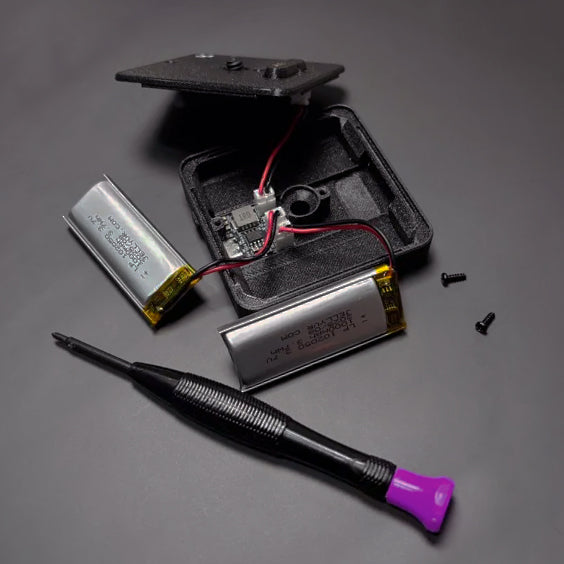
3.7v 1000mAh LiPos - Jelly Pucks V2
Couldn't load pickup availability
Shipped from within the EU, no customs fees or import duties.
⚙️ These are spare parts for Jelly Pucks V2
✅ 2 x 3.7V 1000mAh LiPo cells
✅ Replacement batteries, plug-in, no soldering
✅ JST PH 2.0 connector, 40mm lead
✅ Protection for overcharge, over-discharge, short circuit
✴️ Important:
• Batteries come paired, always replace both at once.
• Don't mix batteries across different pucks, or with older cells.
• Only use with Jelly Pucks V2.
📦 Included:
• 2 × lithium polymer battery
Specifications
📟 Technical Specifications:
| Specification | Value |
|---|---|
| Voltage | 3.7V nominal (4.2V when fully charged) |
| Capacity | 1000mAh per cell |
| Connector | JST PH 2.0 |
| Protection | Overcharge, over-discharge, short-circuit |
📐 Measurements:
| Specification | Value |
|---|---|
| Cell Size | ~50mm × 20mm × 10mm (per cell) |
| Cell Weight | 22g (per cell) |
| Connector Length | 40mm |

📑 Documentation:
3D Print Files - Jelly Pucks V2
🧊 3D Models:
JellyPuckV2.3mf / STL Files: Download (ZIP 2.9mb)
Provided under Creative Commons CC BY-NC-SA 4.0
- bottom*.stl - Shell bottom (battery side). Multi-filament and solid versions.
- top*.stl - Shell top (pogo pin side). Multi-filament and solid versions.
- interface*.stl - Pogo pin Interface. 2 and 6 pin versions.
- chargingpcb.stl - Charging PCB model reference.
- pogopinpcb.stl - Pogo pin PCB model reference.
- screwjig.stl - For screwing interface and top together.
- solderjig.stl - Aligns pogo pins for soldering. 2 and 6 pin versions.
🖨️ Print Settings:
- Filament: PETG
- Nozzle: 0.4mm
- Layer Height: 0.2mm
- Infill: 25%
- Wall Loops: 6
- Top Layers: 5
- Bottom Layers: 3
🛠️ Assembly:
Before ordering parts to build your own, make sure you can print the files, the button tab moves, and they dry fit together with a click!
Full printing/assembly guide coming soon...
- Jelly 🚧🛠️
Lithium Battery Safety
Certification:
- All JellyVR lithium batteries are covered by UN38.3 test reports and summaries, MSDS, and air and sea transport classification reports. Testing is carried out by CNAS-accredited, ilac-MRA recognised laboratories. Available to carriers and customs on request.
Charging:
- Charge on a hard, non-flammable surface. Do not charge unattended.
- Stop charging and disconnect if the unit becomes unusually hot, swells, smokes, or smells.
Damage:
- Stop using any battery that is swollen, punctured, dented, crushed or has damaged wiring or insulation. Do not charge it.
- Do not disassemble, puncture, crush, short-circuit, immerse or expose batteries to fire or temperatures above 60 C.
- Store and use between 0 C and 45 C. Do not leave in direct sunlight or in a vehicle.
Accidental Exposure:
- A ruptured battery can leak corrosive electrolyte. Rinse skin and eyes with water (eyes: 15 min, no rubbing), fresh air for fumes, then seek medical advice.
- In the unlikely event of fire: flood with plenty of water. Smoke is toxic.
Disposal:
- Do not dispose of batteries in household or general waste. Recycle in accordance with your local laws.
Works flawlessly,
They just work, charge fast and lasts forever. They are rock solid and are easy to diy not had a single problem with them during heavy use.